Domino Chain Probabilities and Their Impact on Tournament Victories in Online Cash Events
 Observers note that domino games in real-money online tournaments rely on sequential placements where each tile affects future options, and researchers have developed models to quantify how these chains translate into victory odds. Data from multiple platforms indicate that players who optimize chain formation achieve measurable edges in bracket-style competitions, while random play correlates with lower advancement rates according to aggregated tournament logs.
Core Elements of Domino Chain Structures
Domino chains form when participants connect tiles by matching numbers, creating linear or branching sequences that restrict or expand available moves as rounds progress, and experts apply graph theory to represent these connections as nodes and edges where each placement alters the degree of connectivity in the remaining set. Studies show that longer uninterrupted chains reduce the opponent's decision space because they deplete high-value matching numbers faster, and this dynamic appears consistently across double-six and double-nine variants used in cash tournaments.
Probabilistic Frameworks Applied to Sequences
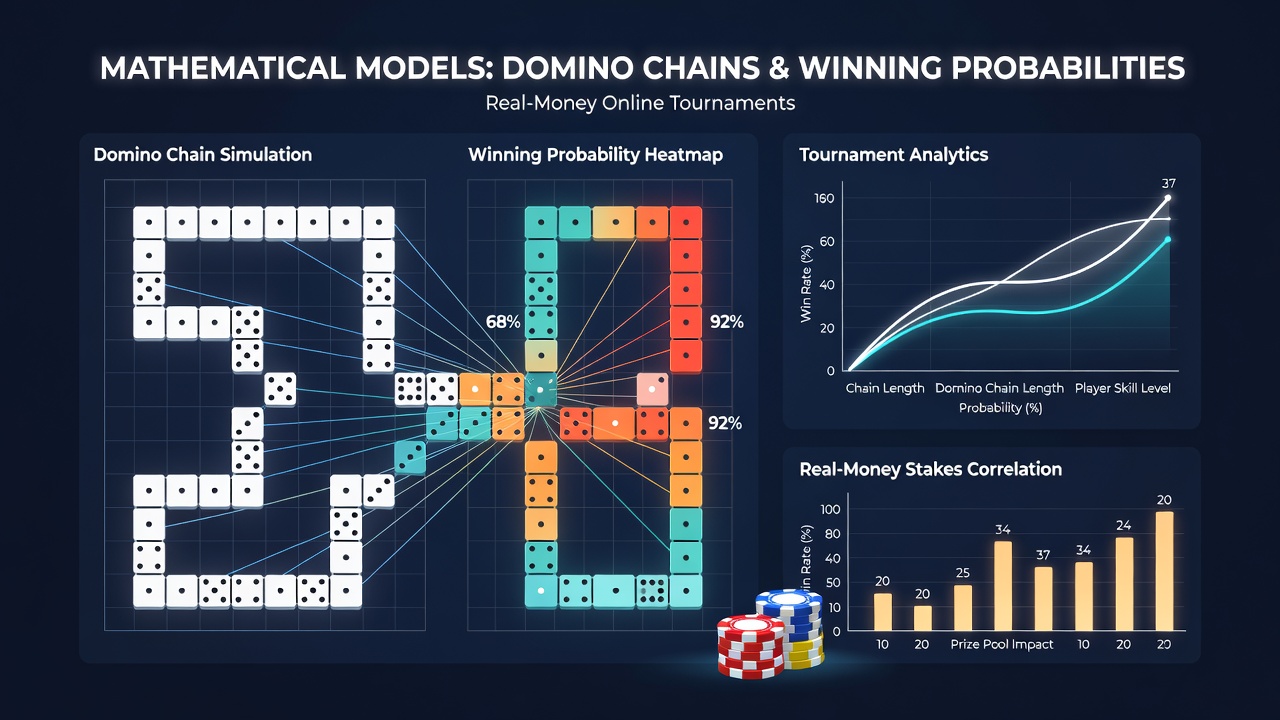
Markov chain models capture state transitions between partial chains and full board configurations, with transition matrices built from historical match data that assign probabilities to each possible extension based on the tiles already played, and Monte Carlo simulations run thousands of iterations to estimate end-state distributions for given starting hands. Researchers discovered that incorporating chain length as a variable improves prediction accuracy over simple win-rate calculations because extended sequences correlate with higher point totals when scoring rules reward the final player who empties their hand.
Bayesian updating further refines these estimates by revising prior probabilities after each move, allowing real-time recalculation of a player's advancement chance within a multi-round bracket, and figures from platform analytics reveal that such updates shift projected win probabilities by 15 to 25 percent in mid-tournament stages when unexpected chain breaks occur.
Integration With Tournament Payout Structures
Real-money events distribute prizes according to final rankings, so models link chain-derived probabilities directly to expected value calculations that factor in entry fees and payout tiers, and analysts at academic institutions have mapped these relationships using regression techniques on anonymized results from thousands of completed brackets. As of July 2026, several operators reported that participants employing probability-informed chain strategies showed higher average returns across repeated entries, though variance remained substantial due to the inherent randomness of tile draws.
Empirical Validation From Platform Data
Industry reports compiled by the Alcohol and Gaming Commission of Ontario track performance metrics across licensed domino competitions, and those datasets demonstrate statistically significant associations between chain completion rates and top-three finishes when controlling for player experience levels. One study from an Australian research group examined over 50,000 matches and found that chains exceeding seven tiles in length boosted advancement odds by approximately 18 percent in elimination formats, with the effect strengthening in larger fields where more opponents compete for limited payout positions.
Additional work published on arXiv examined combinatorial enumeration of possible chain endings and confirmed that exhaustive calculation becomes computationally intensive beyond double-twelve sets, leading most operational systems to rely on sampling methods instead of exact enumeration for live probability displays during events.
Limitations and Ongoing Refinements
Current models still struggle with incomplete information about opponents' hidden tiles, which introduces uncertainty that simple chain metrics cannot fully resolve, and developers continue to integrate machine learning layers that learn residual patterns from post-match reviews. Regulatory bodies in multiple jurisdictions require transparent disclosure of any automated assistance tools, which has prompted clearer separation between player-driven decisions and background probability calculations supplied by tournament software.
Conclusion
Mathematical models that connect domino chain formation to winning probabilities provide structured ways to interpret outcomes in real-money online tournaments, and continued data collection supports incremental improvements in predictive power. Platforms operating under oversight from various regional authorities maintain records that allow ongoing validation of these approaches while participants apply the resulting insights during competitive play.