Patterns of Probability: Dice Mechanics in Backgammon Informing Broader Game Design

Backgammon relies on two six-sided dice that generate 36 equally likely outcomes on every roll, and this structure creates distinct probability patterns that shape player decisions from the opening moves through the endgame bearing-off phase. Researchers at academic institutions have documented how these patterns extend beyond the board to influence mechanics in video games, tabletop designs, and digital simulations where random elements must balance with strategic choice.
Core Dice Distributions and Their Impact
Each roll produces sums ranging from 2 to 12 with frequencies that follow a bell curve, where 7 appears six times out of 36 while 2 and 12 each appear once, and observers note that players who internalize these ratios adjust their checker movements accordingly. Doubles occur with a probability of 1 in 6, yet they allow four moves of the same number, which accelerates progress when they land favorably and creates opportunities for blocking or hitting that alter the entire position. Data from game analysis platforms shows that consistent accounting for these frequencies improves long-term results across thousands of recorded matches.
Application in Risk Assessment Models
Designers who study backgammon mechanics often incorporate similar layered probability systems into their own titles because the game demonstrates how a single roll can shift multiple variables at once, including hitting blots, forming primes, and controlling key points on the board. In July 2026 the International Game Developers Association released findings from a multi-year review of chance-based systems that highlighted backgammon as a reference point for titles seeking to reward pattern recognition without eliminating uncertainty. Those findings indicated that games adopting comparable dice or random generators maintained higher player retention when the underlying probabilities remained transparent and learnable over repeated sessions.
Extending Patterns to Contemporary Titles
Modern board and digital games frequently adapt the backgammon approach of using two independent randomizers to create combined outcomes, and this method appears in racing games, resource management titles, and area-control designs where movement or event resolution depends on summed results. One study from Stanford University's game design lab examined how these mechanics prevent deterministic play while still allowing skill to emerge through positioning and timing choices. The same research connected backgammon's doubling cube to modern escalation systems in competitive games, noting that optional multipliers based on position strength encourage calculated aggression rather than pure luck reliance.
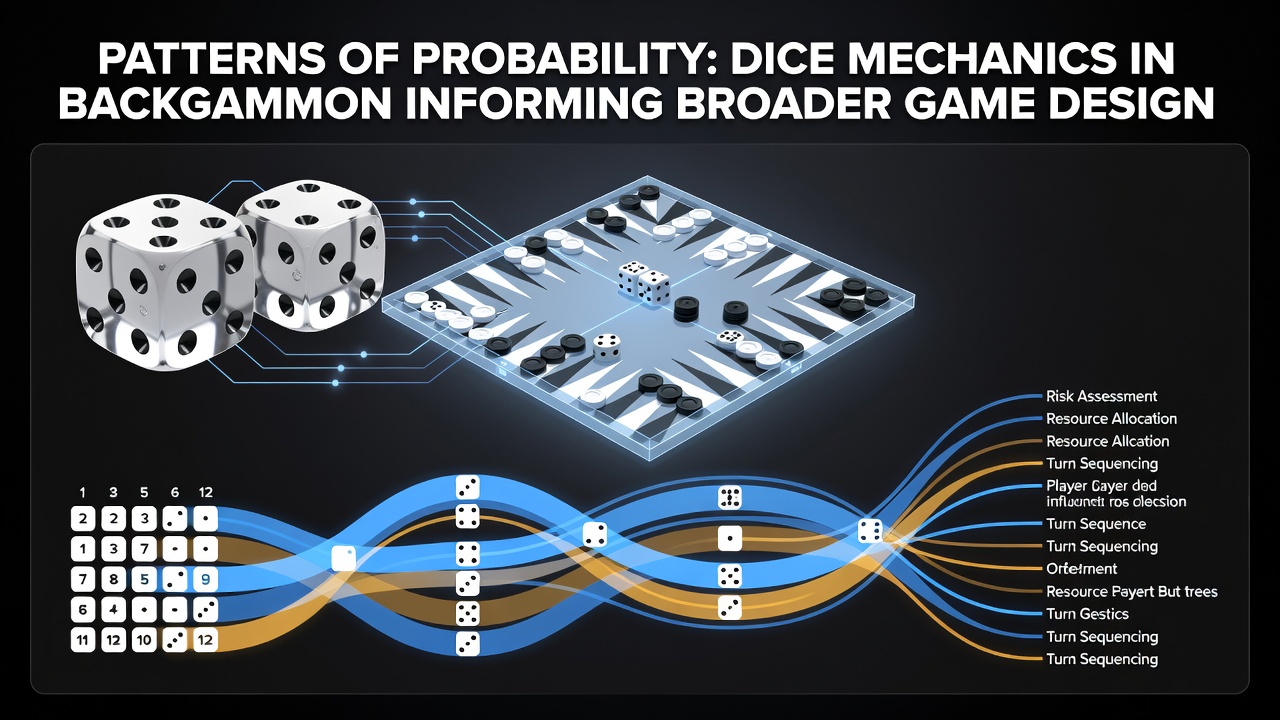
Designers have also examined how backgammon handles variance through the interaction of dice results with board state, since a favorable roll means little without an open path while an unfavorable roll can sometimes be mitigated by prior setup. This principle surfaces in strategy games that layer terrain effects, card draws, and unit abilities over base randomizers, and analysts at the Game Theory Research Group in Toronto documented cases where such layering reduced frustration compared with single-layer randomness. Their reports emphasized that players respond positively when the system reveals enough information for informed decisions without removing the element of surprise.
Statistical Insights from Large-Scale Play Data
Analysis of millions of online backgammon matches reveals that winning percentages correlate strongly with the ability to maximize expected value across sequences of rolls rather than relying on any single outcome, and these findings have informed balance patches in several digital strategy releases. Industry reports from the European Interactive Digital Software Association further connect backgammon-style probability modeling to player progression systems that reward consistent positioning over isolated lucky breaks. Observers tracking adoption rates note that titles incorporating these lessons show steadier engagement curves across skill brackets.
Conclusion
Backgammon's dice framework continues to supply concrete examples for game creators who need to integrate chance without undermining strategy, and the patterns of distribution, doubles, and positional interaction remain relevant as new platforms emerge. Research institutions and design organizations continue to reference these mechanics when evaluating random systems, while developers apply the lessons to maintain fairness across expanding audiences. The core structures established centuries ago still guide decisions about transparency, variance, and player agency in games released today.